
Instrument Rating · Part 61
Above the weather
Your private certificate says you can fly. Your instrument rating decides how often. Learn it at your own pace, with the same instructor the whole way through.
What the FAA requires under 14 CFR 61.65
50hrs
Cross-country flight time as pilot in command, at least 10 of them in airplanes.
40hrs
Actual or simulated instrument time.
15hrs
Of that instrument time flown with an authorized instructor.
250nm
One IFR cross-country with your instructor, along airways or ATC routing, with an instrument approach at each airport and three different kinds of approaches.
These are minimums, not estimates. Most pilots fly more than the minimum, and that is normal.
What the rating changes
The clouds stop being a wall
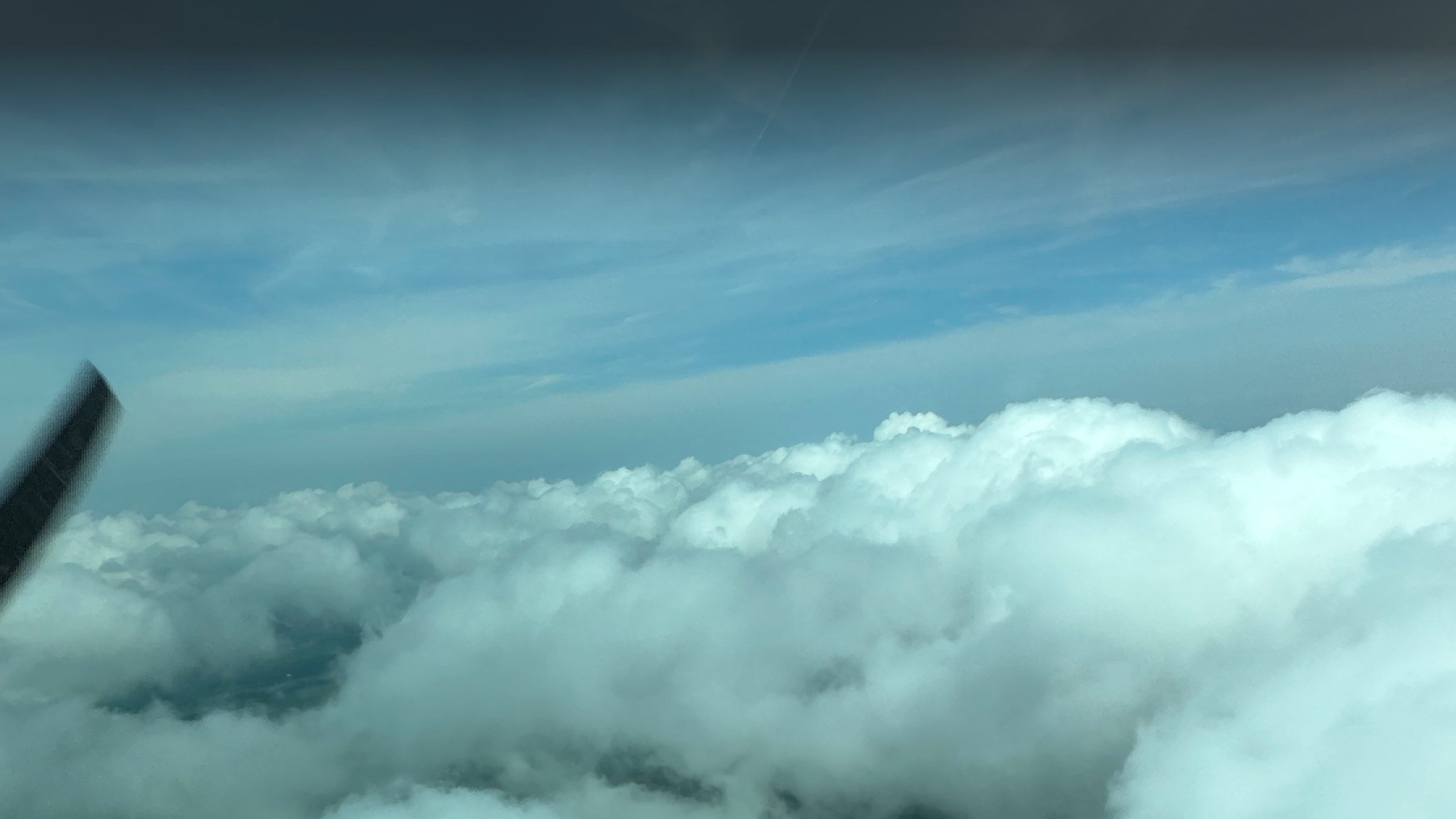
A private pilot certificate keeps you in visual conditions. The Eastern Shore does not always cooperate. A marine layer sits over the coast until mid-morning, a front slides through on a Sunday afternoon, and the sky is perfectly flyable a thousand feet above where you are standing.
An instrument rating is how you get up there. You learn to fly the airplane by reference to the instruments alone, to work inside the air traffic control system, and to fly an approach back down to a runway you cannot see until you are nearly on it.
You launch on days you used to cancel
Overcast at 1,500 with clear skies above it is a no-go without the rating. With it, it is a climb through and a normal flight.
You get home
Most of the value is in the return trip. Weather that moved in behind you is the reason trips get abandoned, and it is the reason this rating exists.
You fly a system, not a picture
Clearances, holds, approach plates, precise altitudes and headings. The discipline carries back into every clear-sky flight you make afterward.
An instrument rating widens the range of days you can fly. It does not erase the days you shouldn't. Knowing the difference is most of what the training is actually for.
How you'll learn
Nobody should have to drive somewhere to be read a slide.
Traditional ground school bills you by the hour to sit in a room and be taught a syllabus at the room's pace. There's a better way to do it, and it doesn't cost you more: you take the material in at your own speed, and your instructor's hours go to the part only an instructor can do.
01
Take the material in at your pace
You work through a professionally produced online instrument course section by section. Early mornings, lunch breaks, whenever you are actually sharp. Rewind anything. Nobody is waiting on you and you are not waiting on anybody.
02
Sit down with your instructor, regularly
After each section you go through it one-on-one. What landed, what didn't, and the questions a video can't answer. Your instructor is registered inside the course and can see where you are before the session starts, rather than asking you.
03
Then go fly it
Each section's knowledge goes into the airplane while it is still fresh. You are not learning holds in theory in January and flying one in April. Ground and air stay a few days apart, the whole way through.
On a screen or across a table. Your call, and you can change your mind. The one-on-one sessions happen either way and they happen regularly. Some people think better on a screen share with the approach plate up between them. Some want to be in the room. Neither one is the real version and neither one is the discount version.
Some students do every session in person and never open a laptop. That works here too. What we are not going to do is charge you to sit in a classroom being told things you could have learned at your kitchen table.
The airplane
A Cessna 182, set up for instrument work
High-performance, fixed gear, and equipped with enough redundancy that a failure in the air is a training exercise rather than an emergency. You train on this panel and you take your checkride in this airplane.
Primary flight display
Aspen Evolution Pro MAX
Attitude, altitude, airspeed, heading and vertical speed on one electronic display.
Multifunction display
Garmin GTN 750
Touchscreen navigator with a continuous moving map showing the aircraft's GPS position.
Autopilot
Two-axis, integrated
Coupled to the navigation system. You will learn to use it, and to fly without it.
Everything has a backup. Behind the electronics sits a full set of analog instruments. Airspeed, attitude, altimeter, vertical speed, turn coordinator and directional gyro, plus a standby vacuum system and a second nav/comm. Lose the glass and you fly the approach on the gauges. That is not a hypothetical here: it is a lesson.
Failures happen on purpose. Your instructor can dim the primary display to nothing mid-flight and leave you flying the approach on the analog instruments. Not a sticky note over a screen, but a panel that has genuinely stopped telling you anything. That is what a real failure looks like, and it is a lot easier to handle the first time when someone chose the moment.
The autopilot couples to approaches, and you'll learn it both ways. Knowing how to let the airplane fly the approach while you manage the radios and the weather is a real skill. So is knowing what to do the moment it disconnects. Neither one is optional.
Those three primary components together are what the FAA defines as a Technically Advanced Airplane under 14 CFR 61.129(j). A commercial certificate requires ten hours of training in a complex airplane, a TAA, or a turbine-powered airplane. This airplane is the TAA route, and that time can be logged here.
What it costs
You pay for the hours you use
There is no package to buy, nothing to use up, and no financing to sign. Both the airplane and your instructor bill to the tenth of an hour. Airplane time is Hobbs time. It starts when the engine does, so taxi and runup are included. Instructor time is on the clock: a debrief that runs twenty minutes is three tenths, not a full hour.
A typical instrument rating here
about $13,260
Built from an hourly airplane rate and an hourly instructor rate. The full breakdown, line by line, is on the pricing page. It is an estimate, not a quote and not a cap. Fly often and finish under it. Leave three weeks between lessons and you will pay to re-learn things you already learned.
Not included: the FAA examiner's fee, paid directly to the examiner and typically in cash, the FAA knowledge test fee, and the online course, which you buy direct from the provider. If you are well short of fifty hours of cross-country time, some additional flying may be needed. We will tell you where you stand before you start.
Getting started: an application and a $500 deposit. The application is where we collect the identity documents the TSA requires before instrument training begins. A federal requirement, not ours, and worth starting early. The deposit goes into your own account and is drawn down as you fly. We ask you to keep that balance positive.
Whatever is left when you finish comes back to you. It was never our money. If you stop training, the same is true. The unspent balance is yours.
Your rate is your rate. If our prices change, they change for pilots starting something new. They never change for someone already in training. You finish at the price you started at, and if you come back later for a commercial certificate, you will know the new rate before you begin, not after.
You build the 50 hours as you go. The rating needs 50 hours of cross-country as pilot in command, and most of it does not have to happen before you start. You are pilot in command on your own training flights, so whenever a lesson goes somewhere that counts, the same hour builds instrument time and cross-country time together.
Easton is usually our answer. It is just over fifty nautical miles from Ocean City, it has a control tower worth the practice, and it sits clear of the Washington SFRA. File out, land full stop, stretch your legs, file home. Two legs, both of them counting.
Not every lesson can be a cross-country, though. Approaches and holds happen close to home. If you are arriving well short of fifty hours, say so at the first conversation and we will look at your logbook and tell you honestly whether the training flying covers it or whether you need some hours on top.
There is a better way to fly some of those hours. We fly rescue transport missions through Pilots N Paws, moving dogs and cats to the foster homes, rescues, and families waiting for them. We don't charge you for these flights. Not the airplane, not the instructor. You fuel it at the end of the day, and that is the entire cost. Your FAA Certified Flight Instructor is aboard, you are the one flying, and the hours count. When a mission comes up and the airplane and an instructor are both free, we let the students who could use the time know, first come, first served. Missions appear when they appear, so treat it as a good way to fly some of those hours rather than something you can plan around.
Not sure which parts apply to you? Call 844-FLY-OCMD or email Fly@EasternShoreFlightCo.com and we'll work it through with your logbook in front of us. The conversation costs nothing and commits you to nothing.
How the training runs
Six stages, in order
Part 61 means the sequence bends around your schedule rather than a cohort's. The order below is how the skills stack, not a fixed calendar.
01
A conversation about where you actually want to fly
The training looks different for someone who wants to reach a family house four states away than for someone who wants to be safer on the same hundred-mile hop. We start there, and we tell you honestly whether the rating is your right next step.
02
The knowledge, section by section
Course material, then a one-on-one session on it, then the flying that uses it. The written exam comes when the sections are behind you and you are already flying the maneuvers they describe.
03
Attitude instrument flying
Controlling the airplane by the instruments alone. Climbs, descents, turns, and unusual attitudes. This is the foundation everything else sits on, and it is the part that feels hardest first.
04
Navigation, holds, and approaches
Flying assigned routes, entering and holding at a fix, and flying precision and non-precision approaches to minimums. Repetition is the whole method here, and it is where most of the hours go.
05
The 250 nm IFR cross-country
One long flight filed under IFR, along airways or ATC routing, with an instrument approach at each airport and three different kinds of approaches using navigation systems. It is the day the separate pieces become one flight.
06
The checkride
You go when you and your instructor are both confident, not when a calendar says so. Examiners book up well in advance, so we start looking at dates early and build in the room to move one if you are not ready. You fly the test in the airplane you trained in.
Questions people ask first
Straight answers
-
No. An instrument rating does not require a higher class of medical than you already hold to fly as a private pilot.
-
Frequency matters far more than total hours. Two flights a week builds a scan; one flight a month rebuilds it every time. Doing the knowledge on your own schedule means your pace is set by how often you can fly, not by when a classroom meets.
-
Yes, and that is the point of billing by the hour. A pilot who already has solid cross-country time, works through the course quickly, and flies twice a week finishes under it. Nobody here has any reason to stretch it out — you are not buying a package, so the hours you don't need are hours you don't pay for.
-
Yes, and plenty of people do. The one-to-one sessions are the same either way. Working through the course on your own first is what keeps the cost down, but if you learn better sitting across from someone from the very start, that is how we will run it.
-
Yes. A portion of your instrument training should include flying in actual instrument meteorological conditions (IMC) when the weather is suitable and it can be done safely.
While many instrument skills are practiced under a view-limiting device ("under the hood") on clear days, that training cannot fully replicate the experience of flying in actual clouds. Real-world IMC introduces factors such as changing visibility, moisture, turbulence, precipitation, and the physiological effects of losing all outside visual references.
Safety is our highest priority. Training in actual IMC, when conditions are appropriate, helps prepare you for the environment you'll encounter after earning your instrument rating. It also allows your instructor to teach practical decision-making and real-world techniques that simply can't be duplicated on a clear day.
Some training will still be conducted under the hood, especially when practicing specific procedures or system failures in a controlled environment. Using both methods provides the safest and most effective training, ensuring you're prepared for real instrument flying—not just the checkride.
-
Actual instrument time is logged whenever you are flying solely by reference to the aircraft's instruments because outside visual references are not adequate. While this most commonly occurs in clouds (actual IMC), it's not limited to cloudy conditions.
For example, on a clear, moonless night departing over the ocean, there may be no discernible horizon. Here on Maryland's Eastern Shore, a departure from Ocean City Municipal Airport (KOXB) on Runway 14 can place you over a black ocean beneath a black sky. Even with clear weather, the lack of a visible horizon means you must rely on your flight instruments to maintain aircraft control. Situations like this demonstrate why instrument flying is about much more than simply flying through clouds.
Time flown under a view-limiting device ("under the hood") is logged as simulated instrument time. Time spent flying solely by reference to the instruments in actual instrument meteorological conditions (IMC) is logged as actual instrument time. Both simulated and actual instrument time count toward the FAA's 40-hour instrument experience requirement, but actual instrument experience provides valuable real-world training that cannot be fully duplicated under the hood.
-
Instrument currency has its own requirements and they lapse quietly. We fly currency checks and instrument proficiency checks for pilots who already hold the rating, whether or not you trained with us.
Instrument Rating
Start with a conversation
Tell us what you fly now, how much cross-country time you have, and where you want to go with it. We'll tell you what it would actually take, including if the answer is that you're not ready yet.